
The second leg of my journey had a little detour in a place called Vishakapatnam (Vizag). Initially I was to go directly to Kondapalli but after gathering tips from local doll makers in Tirupati I decided to visit some neighboring villages of Vizag where dolls are made from wood and polished with lac (plant secreted glue). Dolls from these areas are known for their unique designs and they are recognized from the dull colors used to paint them. While Kondapalli dolls maybe gaily colored and depict King’s processions, Etikoppaka dolls are made with dull earthly colors, used from natural dyes and depicting household utility items and children’s toys. The laborious process of making these dolls has led to this art form almost disappearing completely. Traditionally a tribal practice, wherein these dolls were even used their own rituals; today these dolls are exported out of Etikoppaka to neighboring towns and cities like Chennai where they adorn women’s Golu displays. Nowadays farmers use whatever wood is available to them (not the traditional Alusu maram) and they use synthetic coloring instead of natural dyes. However in recent times one particular entrepreneur has successfully maintained the early practice and ensured its’ continuity through forming a safe company where Etikoppaka dolls and the craft of making them is preserved and taught to new generations.
These dolls are not just used in Golu but I recall having the original Etikoppaka rattle in my own home growing up. 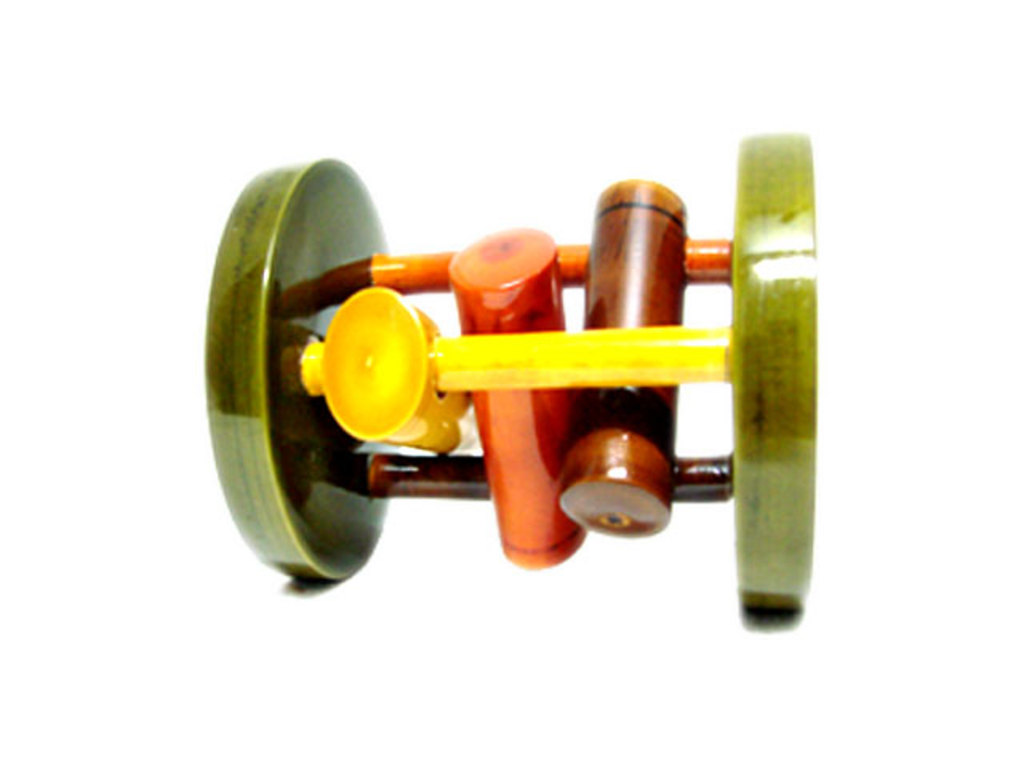 A favorite toy, the rattle has 3 poles covered with circular discs on either end upon which three cylindrical pieces of wood were housed that when rattled make a crackling sound. Safe to chew on for babies, this naturally made doll is a favorite for mothers who want to keep their children occupied but also wanted safety and soft noises.
Having met some artisans I am hooked on the word process. This word came up over and over again in my many conversations with them. The word “process” also came up in my art course as an undergraduate. My professor Ron Mills used to say that art involves “process” without which even the greatest of skills is nothing but a doodle. The process took a painfully long time and involved multiplying one’s simple skill into a masterpiece. For example take Vincent Van Gogh; though one of his skills was the technique of brush-stroke painting, his work becomes art only when he multiplied his technique (stretched across a canvas space with little strokes) to create the Starry Night. The Etikoppaka doll makers are not considered artists, and yet their work involves a similar process: converting a simple technique and multiplying it with years of experience. After all gathering experience is also a process and involves skill, technique, and time. They have experience in the process and the process in turn garners them experience. Perhaps every manufacturer is then an artist? I might be sounding highly capitalist, but in today’s world, where my neighbor makes jewellery that is available on Etsy, what separates an artist from a producer of goods/services? I am confused then about how art derives its’ value. If the artwork is unique and involves a process it has a price – most of Etsy’s creations fall in that category. In today’s economy however (one could even owe it to the printing press) each thing can be re-produced. Pictures are no longer original, copies can be emailed and saved and deleted without ever holding a picture in one’s hand. From where then does art derive its value?
 bommalāttum