“United we stand, divided we fall” – “ekta mei bal hai”

There is no carpool lane in India but I was able to make my journey in the ‘summer summer’ of Tirupati in search on doll makers, all using the Indian carpool system. In the Indian carpool system about 15 people pile into a vehicle that is an autorickshaw cum car combined. This weird looking locomotive has a front seat for the driver with a long seat that can hold about three people. Behind the driver the rectangular vehicle has a sunroof with seating on all four sides. Each passenger sits inside the rectangle facing the other three sides. The back of the vehicle also has seats but these are reserved for young boys who can “rough it out”. The passengers who sit on the back seat allow their legs to hang loose from the vehicle, making them vulnerable to traffic. Piled into this vehicle with a carpool system, I was able to travel a total of 60km by hopping from one stop to another as I searched for the little villages and homes where the doll makers lived.
The professor at SVU had also sent a Telegu speaking student to accompany me. A very patient and observant young man, he made the perfect companion for me. He didn’t speak English very well and he didn’t understand a word of Tamil either. However he combined my broken Telegu with English and managed to find me the homes of the doll makers. By the end of my journey he became a good friend, chatting about politics to me in Telegu while I responded enthusiastically in Tamil. I am sure we were a sight to see. Infact at one the stops we made along the way we met up with a local resident of the village, a young Nurse returning from work. She spoke Telegu and Tamil and we started a three-way conversation among us. The student also showed his expertise in ethnography to me. Throughout our travels he chatted up young boys and girls from the neighborhood and enquired about where these doll makers might live and work. He was also able to find me people that would make good conversation. In ethnography, unlike in a mass-scale or statistical sample based study, people are valuable and not just numbers on a scale. One family with one unique artisan, performer, or ritual specialist, is worth more than a thousand surveys. Between my companion and I, we had struck gold. Two of several families and artisans I interviewed turned out to enrich my research in ways that only time will tell.

Can you keep a secret?

If I didn’t find any information in Chinna Bazaar St, I was supposed to visit the streets alongside the local Vishnu temple in search of doll sellers who may divulge the source of their wares. Here too I faced a different kind of atmosphere. The shop keepers were rather annoyed with me and one even told me to get the hell away. Why the hostility? I hadn’t even talked to anyone yet, I had just tried to take a picture of the street corner. This isn’t the first time I experienced such hatred for researchers/ reporters/ anyone with a camera. Even in Chennai last year, during Golu season, I was shoved around by a large female shopkeeper and an older man as they yelled at me, “oh you photo-takers, you come and sell pictures and our craft suffers. Because of you no one comes to us!” My intention was never to impose myself on these shopkeepers or influence their sales. If anything I hoped my research would create awareness for a dying craft. But their hesitancy and hurt implied to me a different sort of a concern. In a rapidly changing India, where the gap between the wealthy and poor (haves and have-nots) was glossy and visible, these sellers also felt a sense of economic hurt. They wanted a piece of the wealthy Indian pie, denied to them every day and yet flashed in front of their face.

Ethnography, as my professor Don told me, is ultimately about trust. Every time I visit a shop to start enquiring, I try to establish that trust. I tell them about myself and what I am studying but ultimately there will be some who just don’t want to talk to you.

Two of the three shops on this street, who sold the wooden dolls, didn’t want to talk to me and directed me to the one major shop at the very end of the street. There, I was told to return in the evening when the owner’s son would be there. When I returned in the evening I was able to meet the owner’s son but ultimately after a lot of questions he asked me, “Why should I tell you where the dolls are made?” At first I was dumb founded. I realized there was hurt in his voice when he asked me the question. Ethnography also presupposes that our informants will share information. IRB certified or not, I posed a threat to the economies of exchange involved in our conversation. I had tried to tell him that I was only a student writing about dolls. But his ambivalence came from an old fear, one of territoriality. Maybe he had heard of other doll shop owners losing their business to customers who went straight to the source. I realized very quickly that the wooden dolls were also deeply embedded in a socio-economic world of business and trade, where one person’s knowledge of the source, is still the sole capital upon which goods can be sold. If I were to understand these dolls and tell their whole story, I must also unravel the economic webs that have cocooned them over the years.

Eventually human nature prevailed and we were able to establish trust. He asked me to return when the doll makers would be visiting his shop later that week to drop off this week’s supply. I look forward to sharing more conversations with them and my new friend, the owner of this little artifact shop.

Old is Gold?

India academia is so different from American academia. Professors and advisors are called Supervisors. Supervisor is a title that implies tremendous power and authority over a student’s career and topic choices. I would like to think that my professors in the US are more like friends than Supervisors but perhaps I am being too romantic, at some point the relationship between teacher and student is one of power. I met the Dean of the Sociology Department at SVUniversity today as well as a Retd Faculty member from the same department. Both were very encouraging and offered a lot of help as well as clues for me.

Apparently Golu isn’t popular here in Tirupati, as much as it was even thirty years ago. Both professors had vivid memories of visiting Brahmin homes on Chinna Bazaar (Little Shopping hub) Street, a lane flanking the Rama Temple in the area. Golu is known as a Brahmin festival here and one performed by those who are conversant in Tamil, Telegu and English. The one doll maker the Dean remembered was an old Muslim who lived on that street whose son worked at the University alongside the dean. He recalled taking evening walks to visit the Muslim thatha (dear grandfather) and sitting on tea listening to his stories about his craft. This thatha was renowned for his ability to distinguish between a powerful image and a cracked/refurbished /improperly made doll just by looking at it. His son, who worked at the University, has also passed away and never learnt his craft. His youngest son is still alive, and I hope to meet him before leaving Tirupati. Even forty years ago, the amazement and development of the craft of making dolls was a dwindling art form, reserved for the few artisans who remained alive. During the Dean’s childhood, the only customers that remained for the Muslim thatha were wealthy families that had made special orders for their homes.

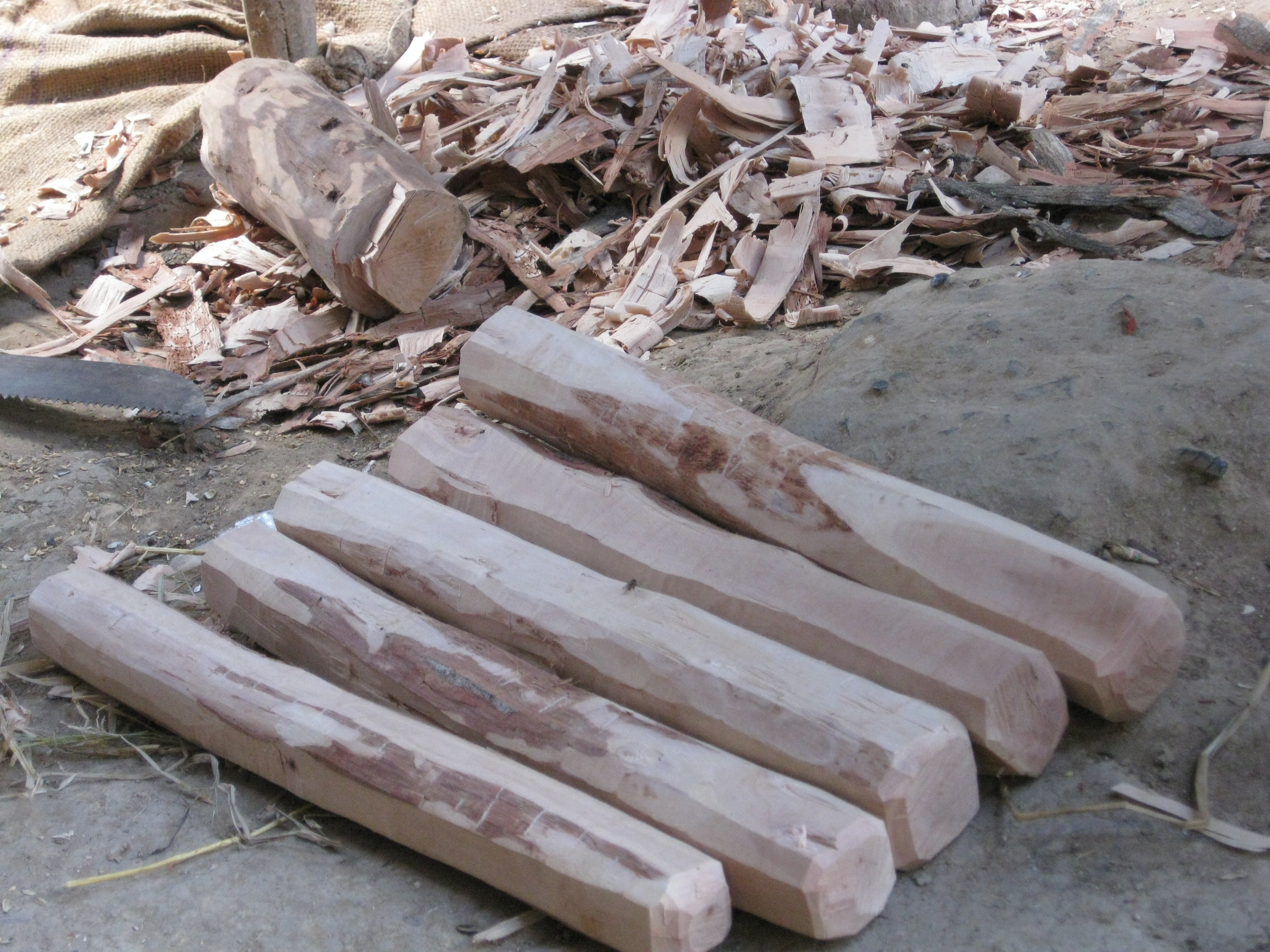
In search of this family I left to meet them and hoped to recover some information about where the wooden dolls might be made. I arrived in the Muslim thatha’s neighborhood in the afternoon, around lunch time, but instead of shops, I found the area was mostly residential except for a few stationary shops filled with unsold notebooks for the upcoming school year. His home was bolted and the family who lives upstairs’ door was also bolted. I enquired in several neighboring little paan (betel leaf) shops and found that only this Muslim family (living amidst a Hindu and Jain neighborhood) was known for “bommalu” or “mara bommalu” (wooden dolls) and no one else knew of the ritual or the dolls. There was no local familiarity for the ritual or its components. A young girl showed me her plastic doll in response to my questions and asked me,”This thing, why do you bother so much with dolls, akka?” Her lack of enthusiasm made me wonder why I cared so much about a seemingly trivial image such as a doll. A plaything of a child, it represents the epitomy of a transient phase in our lives, one that lasts only a few years, but the impression of which, lasts forever throughout, shaping our personalities. Any American would be familiar with the influence of Brabie dolls in the body-dismorphia experienced in teenage and adult women. Maybe the dolls are not as transient and unimportant as we think they are?