Touch me or Touch me not?

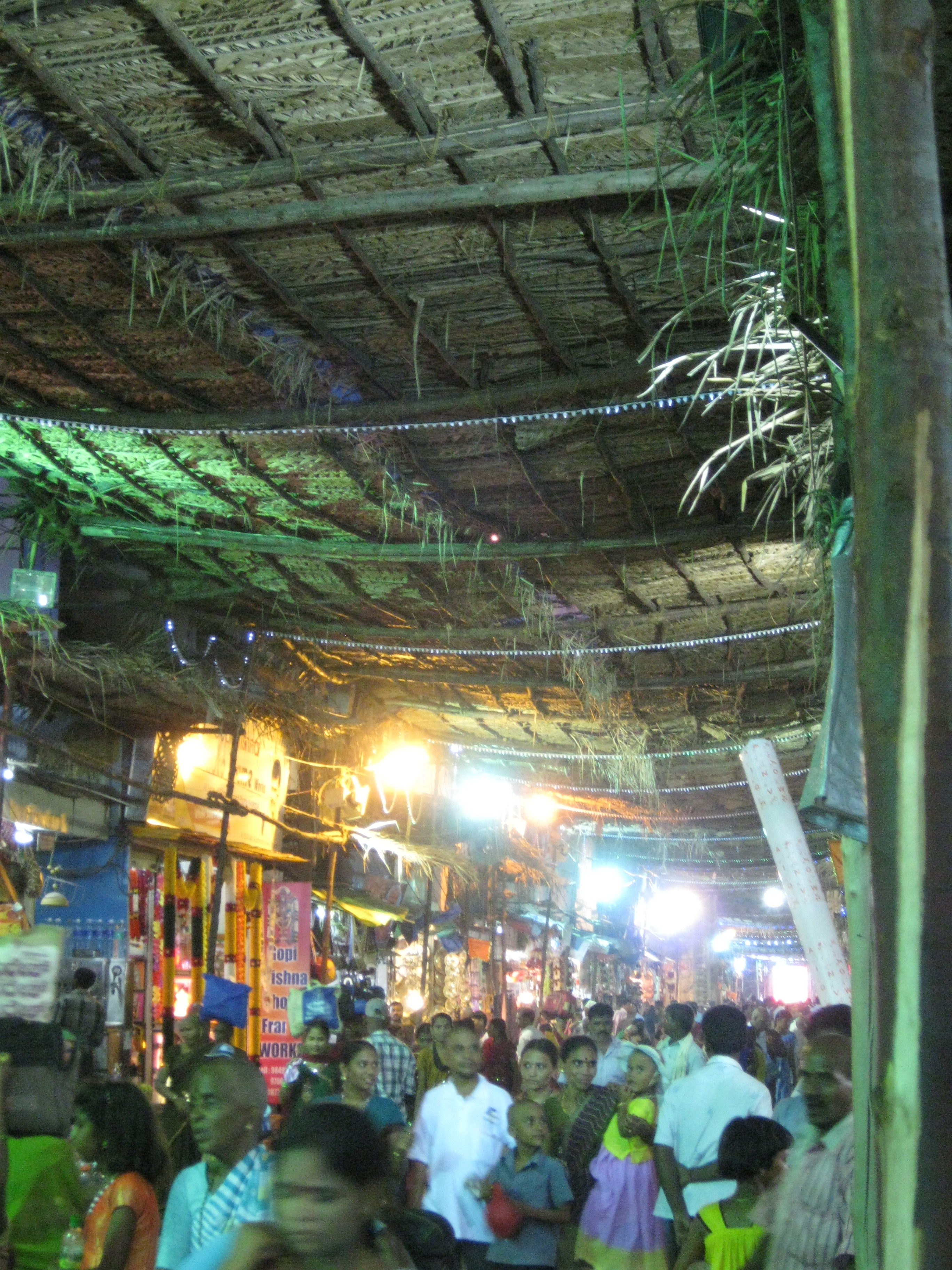
Does the treatment of devotees as passengers on a plane, fundamentally alter the experience of going to a temple? There hasn’t been any scholarship that has tried to articulate exactly why Hindus go to the temple. Some have suggested the sight of the deity to be important (Darshan by Diana Eck), others have suggested that the sacred energy in the temple grounds that transforms the visitors. Whatever the explanation, something is altered when the number of devotees are stripped of their personal belongings and herded through five jail-like rows to get a small glimpse of the central image housed in the sanctum. The principle is one of equalizing and checking the devotees who enter; no easy task in a country of billions. But once inside the different tiers of darshanam tickets also seems to segregate people and make them aware of their “difference” between each other. Some scholars have used Victor Turner/ VanGennep’s analysis that liminality or “dissolving of boundaries” contributes heavily to the experience of temple gatherings, especially when so many people of different socio-economic castes and genders are pressed together into narrow cages and herded in and out of the temple complex. I even saw the officials pushing back at devotees, shoving them quite roughly; one older woman almost fell over under the pressure. Throughout the wait in the lines at TTD (last post), there were many instances of a juggernaut letting loose.

The theory of liminality is so attractive to Americans who claim to refrain from touching each other as much as possible. Locked away in a supposed private and individual bubble most of my American friends wouldn’t be comfortable with the ways in which affection is shown in India. I hug my parents and sleep on the same bed as my family. I also share a lot of physical affectionate gestures with kin – hugs, shoving and grabs with my close girlfriends too. Across genders touching is less acceptable. The pilgrims who press up against each other seem so foreign to the American eyes.

 I remember vividly my very first Orientation in Linfield College, where they told us seventeen/ eighteen year old students not to touch any of our fellow American friends as we may in our home country. We were also told to stay minimum 3 feet away from other people in lines, and social situations. The abhorrence with touch was the first thing I heard as a young international student along with my Japanese and Chinese friends. That tip proved very worthy as later I realized some of my American friends also cower from another’s touch, fearing the touch of their fellow humans for a many reasons which I don’t wish to unpack here. Also germa-phobia and fears of contamination is visible in movies like ‘Resident Evil’ or the fact that most Americans carry hand santizers and pour them over their hands and bodies upon every social encounter. American children sleep separately from their parents too and I recall and friend once observing how odd it was that grown-up family and kin slept lying close together in India.

The second time I heard about an abhorrence to touch was in regards to Brahmin priests and how they treated people of lower castes. Having to maintain strict levels of purity, Brahmin males in ritual situations especially and Brahmin women before they have completed their morning rituals, are very particular about not touching even other family members till they have worshipped god. This doesn’t only extend to “lower caste members” but Brahmins won’t even touch cloth/ fabric and even their own children before the rituals are completed. This hesitancy with touch was heavily criticized by my American peers and is considered the root of the Hindu-caste problem.
In fear of sounding like an elitist Brahmin myself, I have refrained from commenting on the subject of touch. But upon experiencing so much “touching” since I set foot in India, I am confused at what the hullabaloo about upper castes wanting to be pure and untouched really tells us about the western gaze that has interpreted our country? Don’t Americans also hate “touching” each other? What makes un-touchability a privilege of Americans and bigotry of Brahmins? In other words, if Americans can refrain from touch, what makes their actions any less prejudiced? Can we really discern the root of someone’s untouchability by merely observing them?
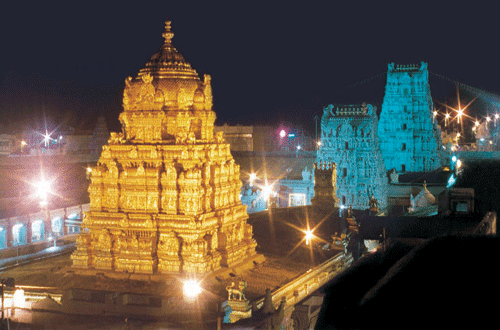
the Steps leading to swarga loka (the Heavens)

The main reason pilgrims visit Tirupati is to see the SriBalaji Temple (Tirupati Tirumala Devasthanam TTD) here, where Srinivasa (Vishnu) himself is said to live. Nestled atop seven hills and hence called “Lord of the Seven Hills” (yezh malai swami), I was able to visit the temple even though I didn’t know if I would have time to do so. Visiting Balaji is no ordinary task and takes stamina and piety. Pilgrims come here in the same way they gather at the famous Jagannath Temple. Getting “darshanam” at this temple is absolves one’s sins and Balaji is said to provide prosperity and wealth to those who visit.

Going to a temple is a journey, and this journey is especially evident in visiting large and popular temples like TTD.  Today areas where large numbers of people gather are vulnerable to terrorist attacks and so also security has increased and no cameras or cell phones are allowed in the area. Entering TTD was a lot like going through security in an airport.  I left a lot my belongings in a luggage deposit center and entered with a bottle of water around 1:00pm to the special VIP entrance. Yes, this is surprising to me and to a family of seven who had come from Kolkota to see this temple for the first time. Unfamiliar to South-Indian temples they asked me why there wasn’t one line for devotees but three tiers. This isn’t unique to TTD. In most popular south Indian temples, except for in smaller shrines, tiered access gives you a lesser wait time. But even within VIP status there was a higher tier for the VVIPs. The free darshanam line began about a mile away from the temple entrance. The actual shrine is much further inside the temple grounds. The Rs.50 line and the Rs.300 line began at the same place, about half a mile from the entrance of the temple. The VVIPs were in the shortest line, one that led straight from the entrance of the main shrine inside. The wait time between Rs.50 and Rs.300 was only about 1 hour. The total wait was about 4 hours. I was able to visit Balaji only at 7:00pm that evening. After the darshanam it took another 2 hours to find my way out of the temple complex. This was not a special festival time but just a usual Thursday evening puja.

What was shocking to me is the amount of devotees who were in the VIP Rs.300 line was as many as those in the Rs.50 or free darshanam line. So India’s middle class can actually afford the entrance fees? These tiers also tell one of the different income levels of Indians today. The free darshanam pilgrims are still the bottom most rung of society. The Rs.50 devotees form a lower middle class. The Rs.300 could be considered middle class and upper middle class while the most expensive darshanam rates were not even published anywhere, there was a select few that made their way directly into the shrine for a hefty sum. Since Balaji bestows wealth to whoever donates to him, devotees also consider it a small price to pay. Moreover, the people in line with me also had packets of Rs.10,000 and larger sums to donate to Balaji. The wealth in India is very apparent and also visibly demarcating. Wealth buys you everything – devotion, health, and pride, that poverty doesn’t and it is so visible.

The ornamental step-like architecture of the temple’s design is said to show the   path up to the heavens, the height indicating the wealth and prosperity of the temple and its honorary donating parties. Hierarchy is everywhere and visible here – human and divine and human-human.

“ikkadu bommalu chestindāru!”

There are two professions for which you cannot have a weak heart. One is a surgery and the other is ethnography. In my travel over 80 km in different directions in search of doll makers, I thought what I was going to find were happy faces, cheerful artisans, a thriving village. Instead I found a struggling economy with cheated and hurt sculptors. This is why I say you cannot have a weak heart while performing ethnography. I left with a heavy heart that day, but I did leave inspired, to tell a story that not everyone knows about.

As I said earlier the search to find these doll makers was the hardest part. The doll sellers didn’t want to tell me and eventually I found most of my contacts from asking the first set of doll makers themselves. Ethnography is about keeping secrets and revealing only some.

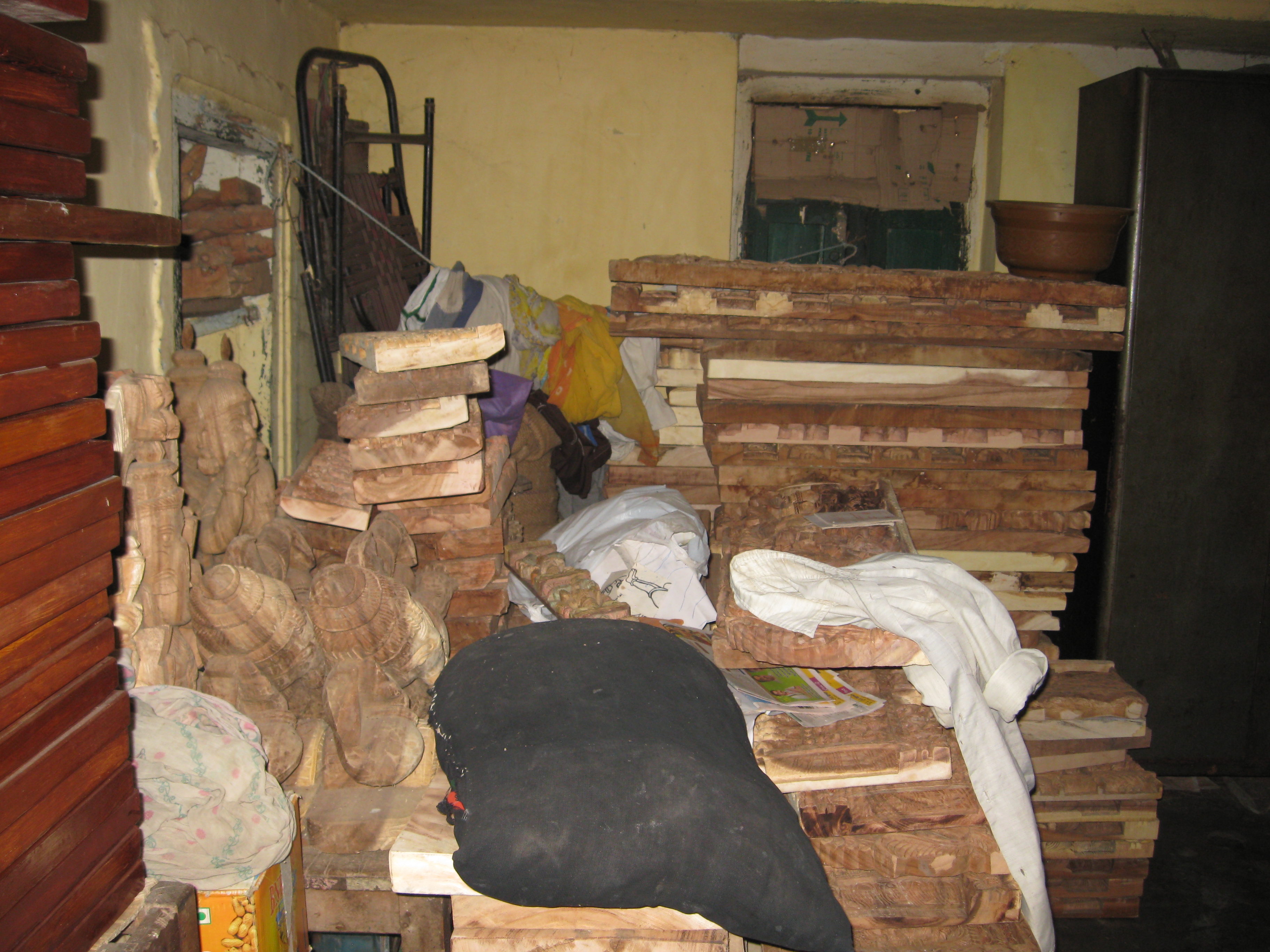
The man you see is about 72 years old and has been making dolls since he was 10 years old. His 75 year old elder brother (who lives next door) taught him how to make images of gods and people using no pictures, just measurements from the Shilpa Shastras (Sanskrit text for sculpting procedures for shilpin “artists”) and from memory. Following his tozhil (“livelihood”) as a defining practice in his life, Thatha achari, a Brahmin doll maker spent his afternoon sharing his technique with me. Made of light and malleable wood, Thatha achari is known for his ability to make “pattabhishekam” – an auspicious image of Lord Rama from the Ramayana. But his skill doesn’t financially support him any longer. He told me of the very same shopkeeper (the one from the street beside the Vishnu Temple who had denied me contacts). He said, “They just come one day, show up suddenly, ask to see how much work I have done i.e. how many pattabhishekam images I have. They take everything we have made till then and give my older brother money for it.” Thatha achari has five children, all of whom decided not to learn his craft. His wife is no longer alive and he still lives in his home, a home built by his grandfather, where his father passed away when he just 2 years old. It took a village to raise him and his village of doll makers raised him to be the best artisan for pattabhishekam Rama.

This little village is also located at an interesting junction. A little road down from the paddy fields that line the highway, Thatha achari’s neighborhood is to the left hand side of the road marker by a little Rama temple. To the right hand side of the road lies a Muslim neighborhood and it too is denoted by a little Muslim shrine. The next village I visited was also similarly multi-religious. Unlike the large urban cities of India, especially Bombay where Hindus and Muslims have been unable to peacefully coexist in the same neighborhood, the two villages I visited housed Christian, Hindu, and Muslim residents. They had their own shrines and they all lived side by side.

Maybe I am sounding too idealistic again. If the Hindus and Muslims are getting along here, there are other problems this village faced. Their crafts and resources are being exploited and the Indian Government is allowing it to happen. The acharis are also holding out for a hero. Their craft is also being forgotten amidst modernization or lucrative professions. Their own children aren’t choosing to learn this craft. However no machine can make these dolls.

In the US artists struggle financially too but there is a sense of autonomy and recognition for their skills and talent. Each of Thatha acharis’ pattabishekam images is not the same and yet they are all treated like products on an assembly line. Like an artist can never draw the same painting twice, each piece is unique. However the market treats every piece the same, like bars of soap, these dolls are also tied together and bundled and herded out of these villages. Where the dolls regain their true individuality is in the homes where they are displayed, through the treatment of these dolls within the homes of men, women and their children. The festival commemoration and display for Bommai Golu challenges this assembly line production, regaining in essence the notion that each piece is unique and not like the other.