
Before you begin reading this you must familiarize yourself with certain commonly Indian and literature oriented caricatures: The popular Hindu and Buddhist Panchatantra, Jataka Tales (Animals Fables) and even British children’s novels like Peter Rabbit and Wind in the Willows or even the famous Aesops Fables and Walt Disney’s Mickey Mouse and Donald Duck. All these fables and stories are like folktales, they get printed and published and read widely in India. When I was growing up TV was not a popular pastime, instead me and my sister used to visit the local lending library or look into my mothers’ old boxes full of English stories and read endlessly in the blistering heat and even on rainy days. The smell of the musty books and the comfort of the morals from the stories made me envision a world where rabbits would invite chipmunks over for tea and the sinister fox would plot to kidnap the little ones as they played outside; Dolls came to life in the enchanted forests and wove magical tales and helped human children be good. Alongside these English tales, the famous Tinkle comics (created by late Uncle Pai) became a favorite with its animated tales of Shikari Shambu (the incidental hunter/conservationist), Ramu and Shamu (twin mischievous boys) and Kalia the crow (the wise crow who would save the animals of the forest from Chamtaka the sinister fox and Doobdoob the hungry crocodile.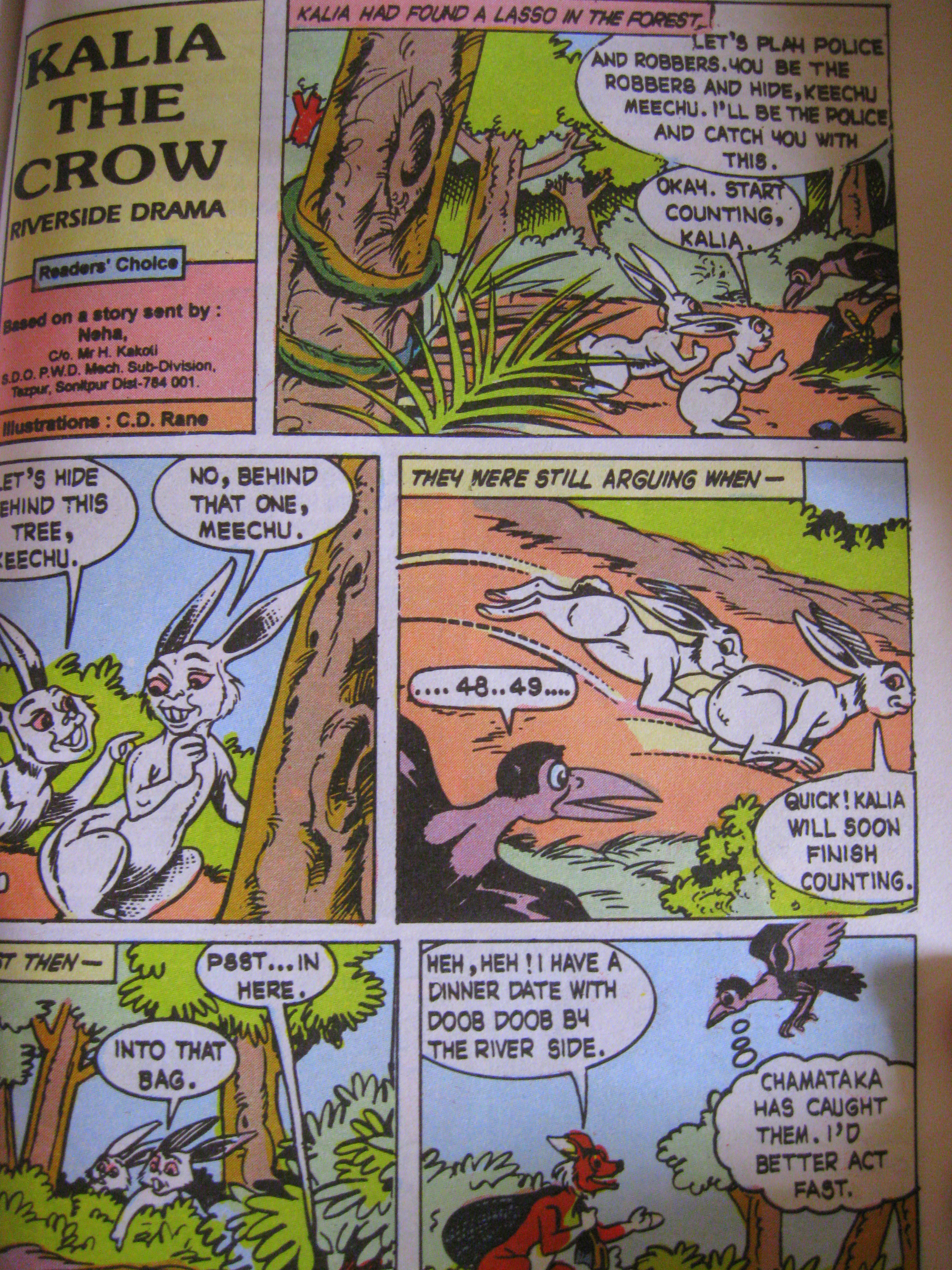
None of these caricatures were so extreme that people discriminated against foxes or crocodiles. Instead every tale would end with a moral. The clever fox ends up being a detective in some stories. Sometimes animals had higher morals than humans in these stories, rationalizing the right over the wrong and punishing the wrong-doers. Chamtaka and Doobdoob since they refused to heed Kalia’s advice, always choose to learn their lessons the hard way, owing to foolishness.
From this vividly rich corpus of literature emerged my present concern for crows. Unlike the Fox that has earned a sly and clever reputation in English (British) and Indian literature and comics, the Owl and the Crow share opposing statuses. While the Wise Owl is a common caricature in British literature, the Wise Crow is more of an Indian thing. The owl in Indian literature is a fool. Prof.Ramanatha Sharma (my first Sanskrit teacher from University of Hawaii, a traditional and illustrious Sanskritist from Benares) used to say, this is why the Hindi word for ‘fool’ is the same as the word for ‘owl’ – “ul-loo”.
In Tamilnadu especially, and in funeral and deceased relative rites (Shraddham), the crow is an important player and participant. Every Tamil girl has heard the story of the wise crow that stole the vadai (crispy salty fried donuts). A hungry crow alights upon a branch of a tree near the home of a vadai-making patti (grandmother). Overtaken by the smell of frying crispy vadais the crow cries out to the old lady to ask for some vadais.  The grandmother doesn’t notice but eventually has to leave the kitchen briefly, leaving a hot plate of freshly made vadais near the window sill. This crow excitedly goes and grabs one and brings it back to his branch where he hopes to eat it. However a fox passing by tempted by the free vadai hopes to cheat the crow and take his vadai. The fox praises the crow’s voice, asking him to sing a song for him, hoping that when the crow opens his mouth to sing, the vadai will fall straight into the gaping mouth of the fox. Crows cries have a reputation of being sore and hoarse and the crow quickly becomes aware of the sneaky plan by the fox. He carefully places the vadai between his claws and sings loudly till the fox is forced to leave because of the noise. Finally in peace the crow enjoys his vadai. There are several variations to this story as there are to any story in India. This crow in some versions drops the vadai and goes to get another one and then finally learns the fox’s trick. In other versions there are two crows and one tries to trick the other while being too lazy to steal a vadai for himself. There are even some versions where the crow is friendly and steals more than one vadai and shares it with the other animal. Whatever the version the crow story is a popular one in Tamilnadu and is familiar to anyone in the area. Crows are popular in the area and their familiar cries can be heard all over the city and countryside. They are all black but with a grey neck. They also don’t eat alone according to popular lore. They taste food and bring all their buddies to share their meal with them.
While scientists have deemed them scavengers, they also play a social and religious function for the Hindu community amidst whom they live. As I mentioned before the funeral and death rites (Shraddham) of Hindu ancestors are performed regularly in the areas surrounding temples by family members with the help of Brahmin priests. During this ritual pindas (balls of rice covered in black seaseme seeds) are made to depict the ancestors of a particular lineage. Crows are said to be ancestors in limbo, searching for food and dependent of humans for their leftovers. Towards the end of a Shraddham, these balls are placed in open spaces where crows gather and they are invited to partake in the offerings. While the priests are the main representatives to be fed in this ritual and the descendant male member who performs the ritual for their family member (owing to the importance of a son), the crows are the next most important participants for this ceremony. If crows did not partake in these pindas, it was a bad sign.
Not only during Shraddhams but every morning while living in Chennai, my mother used to always feed the crows even before she fed the family. My mom used to say that crows only eat fresh and hot rice. They do not even touch old rice. As a little girl I was so moved by these stories I used to tell my friends when I moved to Dubai that I had a pet crow in India.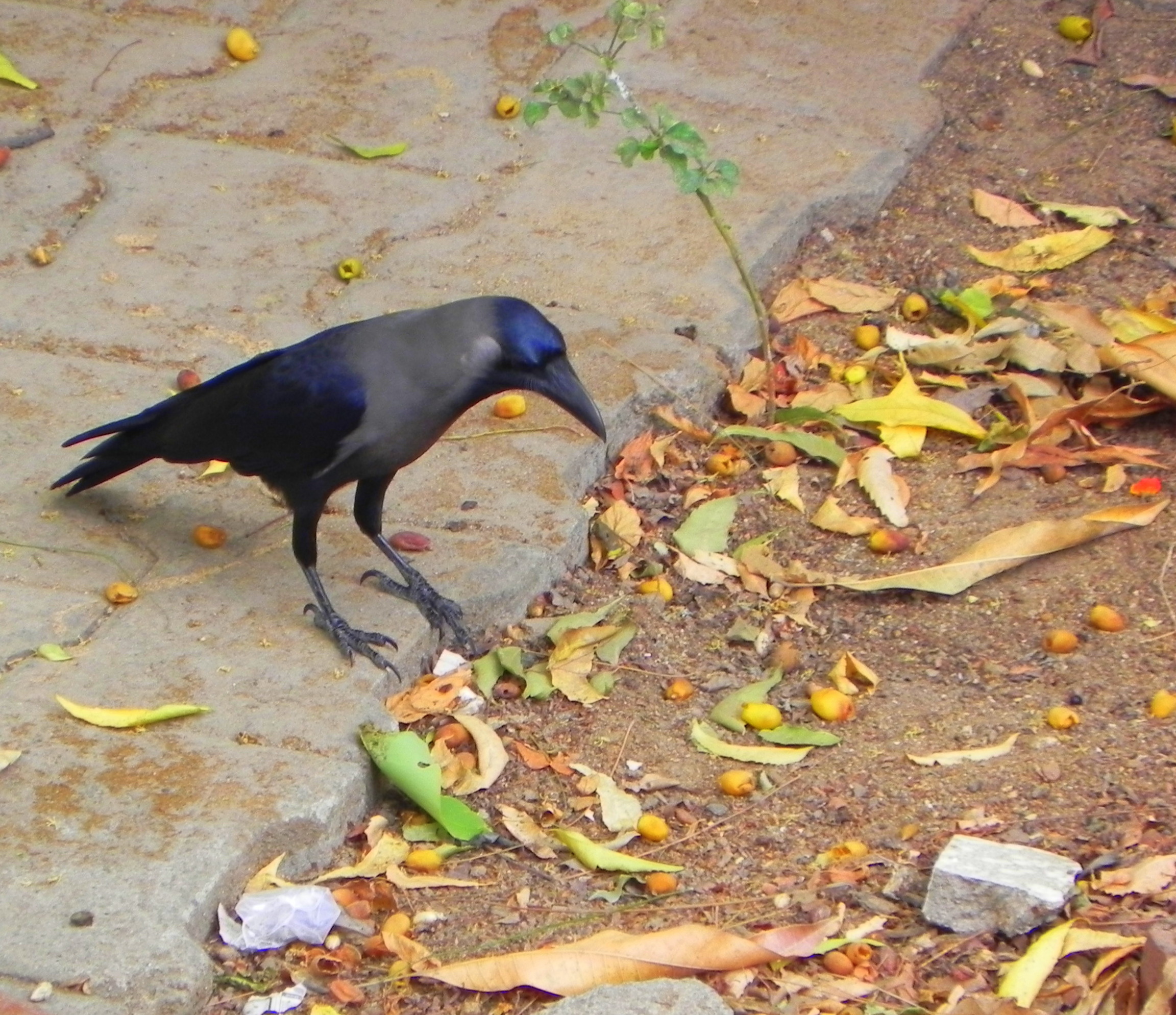
All this to say that increasingly in the hustle and bustle of the city life in Chennai, there are fewer crows. As soon as I arrived I noticed the lack of my pet crows even in my own neighborhood. A friend told me that people throw rocks at them and chase them away these days as they don’t want their pesky loud cries for food in their areas. I was very disappointed especially because my father was visiting to perform Shraddham to my deceased Grandfather and I was worried there wouldn’t be any crows. But whether it was my mother’s devoted feeding of the crows in our area or the fact that crows just happen to remember where food is available, within days of my arrival several crows started to gather outside our window and balcony. Maybe our neighbors hate us even more now?
But the Shraddham was going to be in a different location. There too the scarcity of crows was evident. I went up to the open area and saw a couple of dried up pindas which had remained untouched. I worried for my father. But crows are wise afterall. When my family’s priest began his chanting, a large echo rose from the room where the Shraddham occurred behind closed doors. I was waiting outside keeping a close watch on the pindas but from afar. Crows arrived upon hearing the Sanskrit chants that rang out loud and partook in the offerings, proving the ritual was efficacious.
I cannot make a plea to non-Hindus to save the crow, but I can ask that Hindus remember the important role they play in Tamil and Hindu rites and at least to stop throwing stones at them. Tenderly balanced within the eco-system and worldview of Tamils I fear something is being lost if we lose the wise Crow. If there are no crows to eat pindas, it transforms the efficacy of the Shraddham. The ebb and flow of a developing city however does change the eco-system and these changed will be something the ritual too will eventually have to grapple with.
 bommalāttum