
What is the relationship between fear and devotion? Oftentimes this relationship is articulated through soteriological concerns – salvific roles played by the divine in the coming of the end of the world. Abrahamic traditions also speak of a fear from the “Wrath of God” or the “Judgment of God”. However, bhaya-bhakti means ‘fear of the power of the goddess’. Meaning fear and resulting devotion, bhaya-bhakti is characteristically mentioned by devotees of the goddess in Southern India. The goddess here is considered very “hot” and temperamental. However this temperament is not irrational or volatile to moral humans. It only becomes volatile and uncontrollable once dis-believers ill treat the shrine of the goddess or disrespect another’s belief in the goddess. As the local people say, “You can be of any faith, but there must be a respect for the shakti (power) of the goddess in our area. You need not believe in our faith, but you must never disrespect her power, for her powers are beyond all of us.” It is upon this sense that I wish to share a story told to me by a devotee of the goddess in Tirupati as narrated by her:
In my native village there is an old rock. It is flat, smooth and circular, but it has a triangular chip upon its surface. This chip forms a crack upon the circular rock, making the rock look like a woman’s head with her hair parted. This rock is no ordinary rock, our family’s goddess Karpagambal lives in it. Her powers radiate from the rock.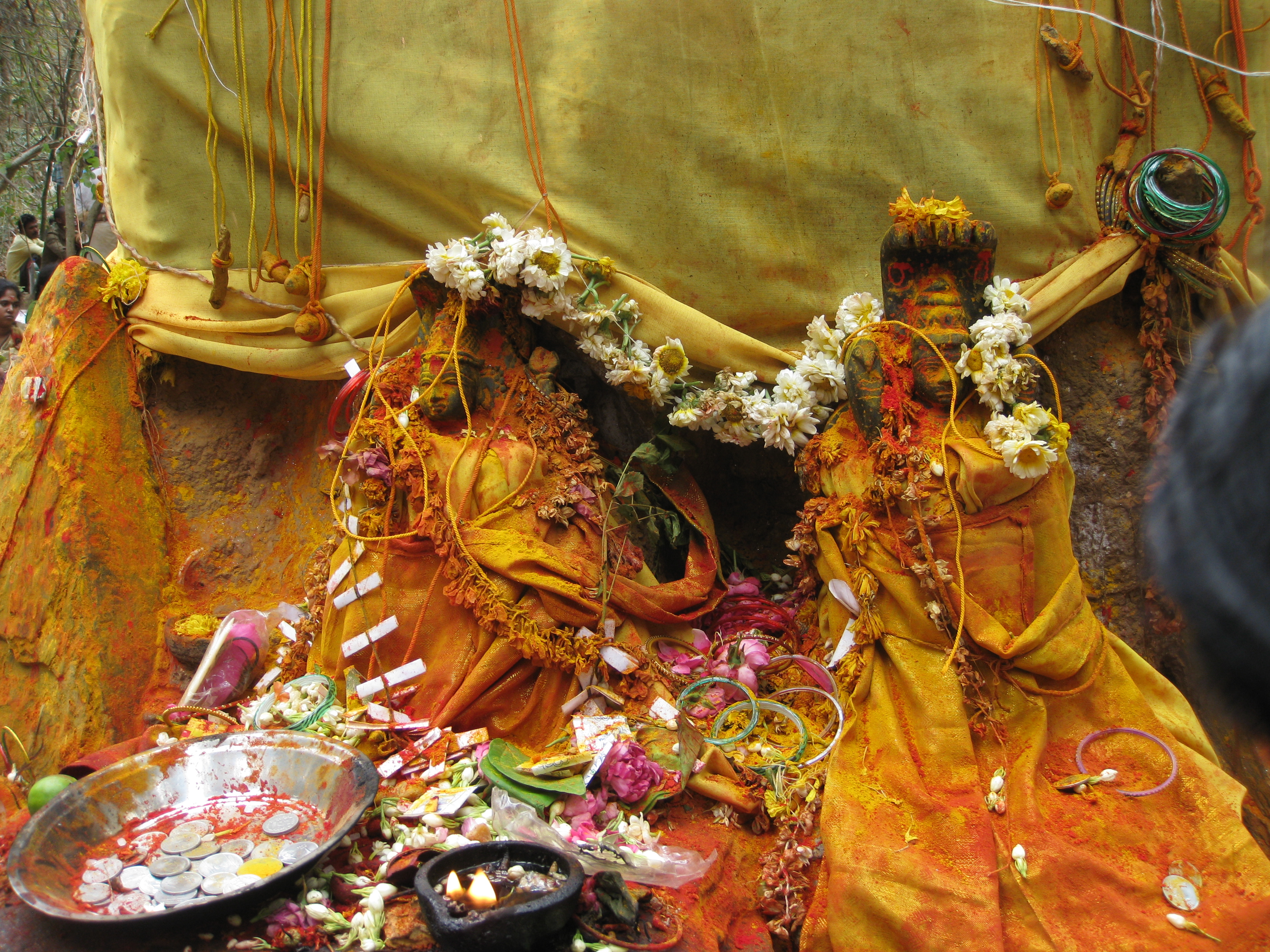
As the story goes, the villagers of the town used to worship Karpagambal in their own shrine upon the cross roads. With the coming of British officers and British employment opportunities (she said vella kārall/ “white people” in the area) our goddess was relegated to ‘superstition’ and no one wished to believe in her anymore, instead they all congregated towards Vishnu or other faiths. But the goddess did not remain silent. To mess with her powers is terrible. She had to make an appearance and so she did. One evening as a group of villagers were working upon a Brahmin landowner’s plot in the area to plough the field the plough stopped and hit upon that smooth faced rock (the above piece), leaving behind the chip and crack. They didn’t think much of it but the plough refused to move from there hindering their work.
That night a young girl came forth towards the old shrine of Karpagambal and cried out loud to the sleeping villagers – “oh you dis-believers, you think that I do not exist? This is only the start, there is much more I could do to stop your entire way of life. I am the goddess, Karpagambal, worship me with my favorite things – pongal (sweet rice porridge), vepa elai (neem leaves), raagi umbli (local porridge), and manjal thanni (turmeric water). I require a bathing every Tuesday with the juice of a special berry.” (Procuring this berry is hard, it is a long process to find it and then to extract the juice takes another few hours. If these are not done correctly one after the other, the berry juice also ferments making it unfit for the goddess.) “If you do not give me these offerings, you will all die and your race will be extinguished.”
Saying this, the young girl became unconscious and had a high fever for several nights. The villagers immediately recovered the stone, made a brick image of the goddess and worshipped with grand celebration on the following Tuesday. This ritual is still maintained till date. This is bhaya-bhakti, I was told, if you do not have fear, then the goddess will appear and make sure you realize her presence. Another woman agreed with my story-teller: “Once a woman bent over the rock to make offerings and by mistake slipped and her own hair parting touched the crack in the rock. She jumped back with fear and an “electric shock”, sensing the immense power emanating from the rock! This is what they say, bhaya-bhakti must be there.”
So to return to my earlier concern, what is the relationship between fear and devotion? The goddess’ judgment is not one that takes effect several years from now, while entering the gates of heaven. Instead the goddess’ judgment is immediate, and life altering, as they say. One could argue that the villagers were challenged and they worshipped the goddess out of fear that their race would be extinguished. On the other hand bhaya/ fear is central rather than in soteriological concerns where salvation is desired. The goddess doesn’t come to save humans but rather to invite devotion to her forms in this world. The goddess’ wrath is in the immobility of the plough, the possession of the little girl, and the surrounding mythologies that bring forth and sense of “this-worldliness” to the goddess’ presence and actions. Moreover, even today the local form of punishment in the villages and surrounding areas of Tirupati is not to call the police. Instead, wrong-doers are brought to the shrine of the goddess, tied to tree there and beaten with a stick. For lack of a better word, there is also a sense of this-worldly karma inflicted upon wrong-doers, assuaging the villagers from the threat of crimes in the area. Ethics – fear- devotion all seem to work hand in hand.
 bommalāttum