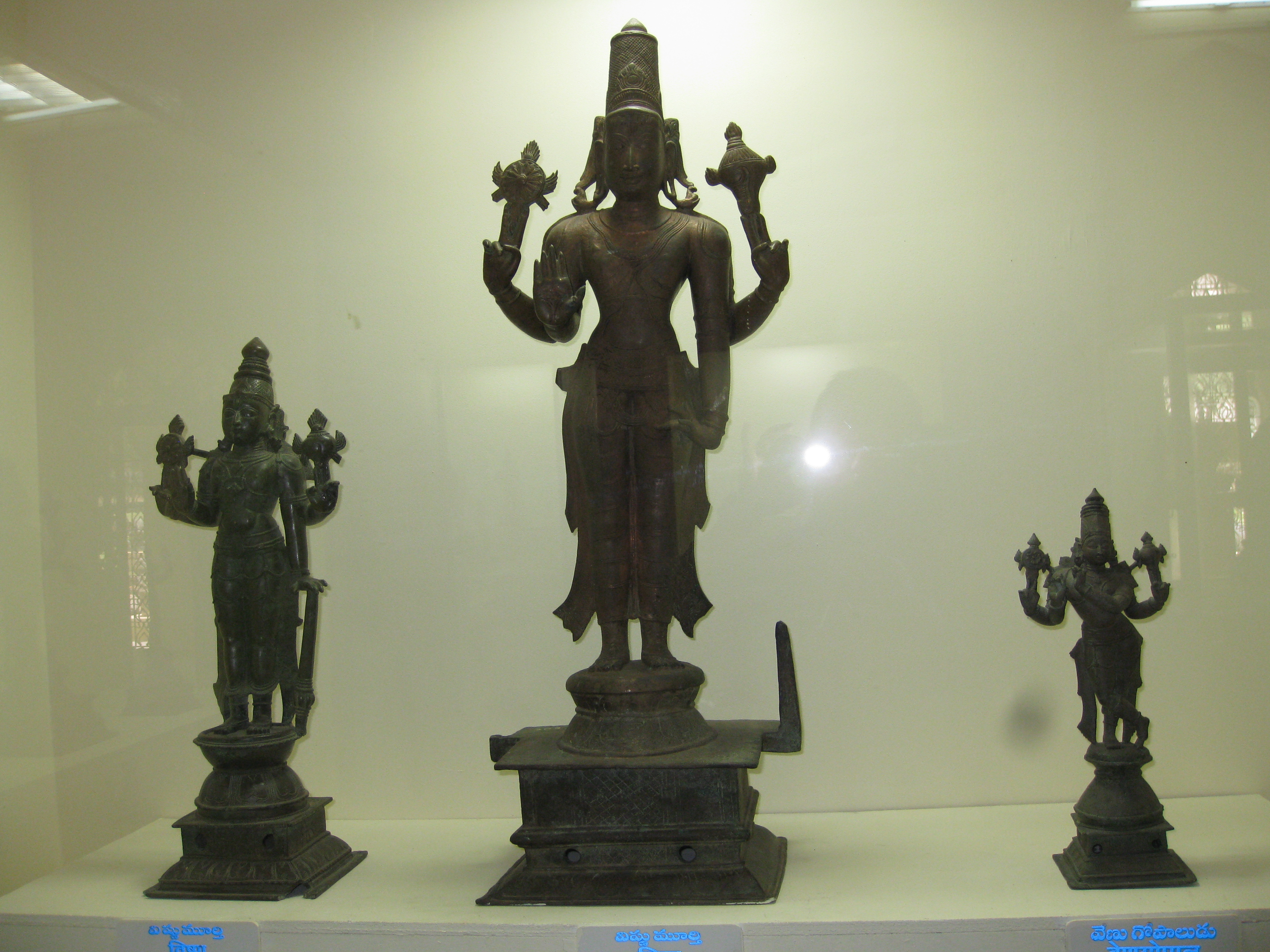
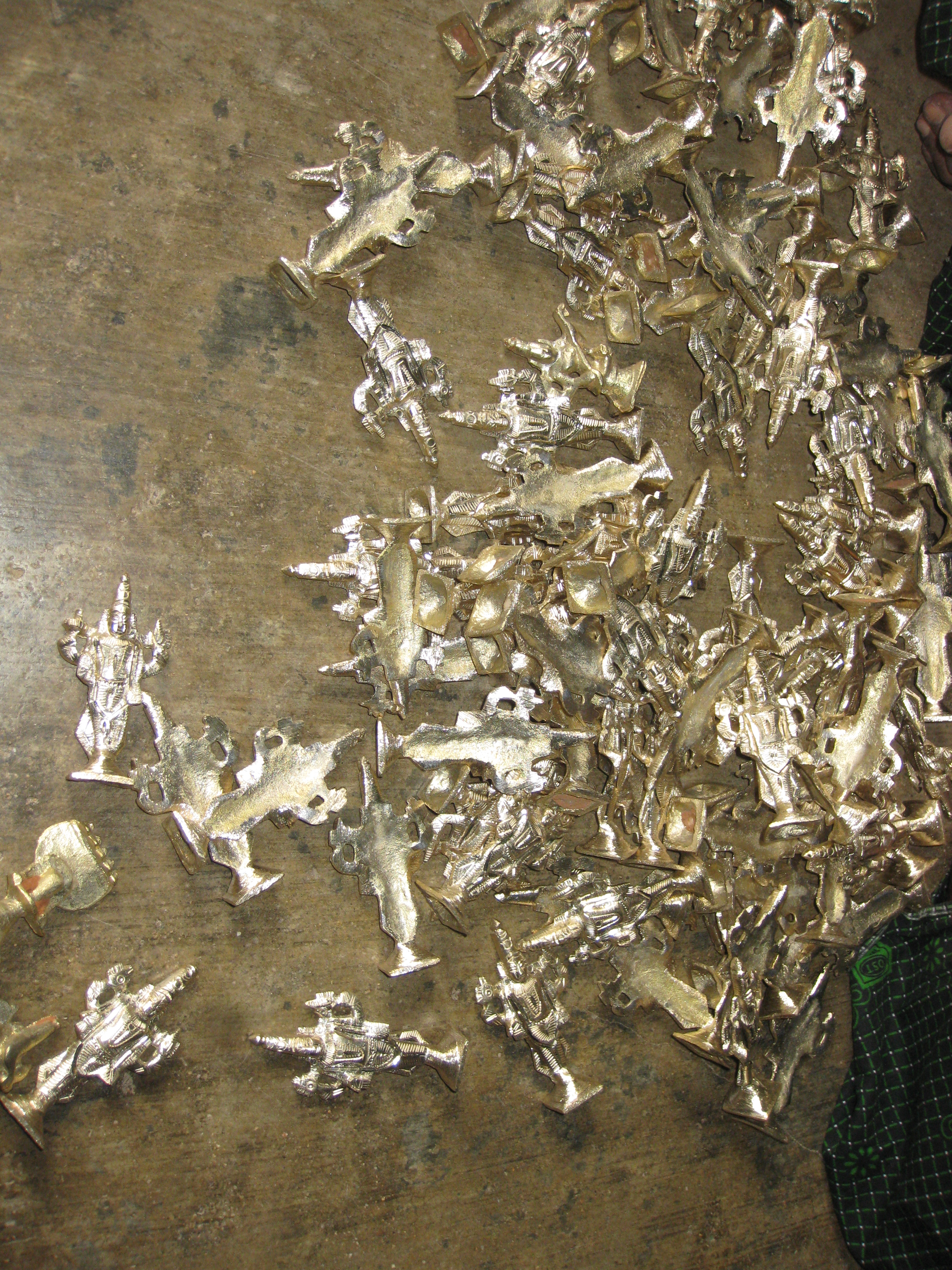
 The English words: manufacturing/ creating/ producing/ cultivating’; whose meanings have denigrated in recent years, have come to indicate a methodical, or systematic abundance of goods and services. Moreover, the plethora of materials of a variety of materials, have caused images to be produced in new forms, shapes and colors. Though my ultimate focus is on religious porull-gal (objects), many other porull have also morphed, making modernity and its’ discontents visible. Take for example the common electrical fuse carrier in all well-constructed Indian homes built from 1979-1990. These boxes, made of porcelain, were built to last – a recent visit to the Indian Electric Office will inform you that the old porcelain boxes “are forever” – lasting many fluctuations, power surges unlike modern, cheaply made fuse boxes. However, porcelain has become a scarce commodity in India in recent years. There are no shocking reasons but rather the global flux and flow of importing commodities into India versus ubiquitous materials invented in recent years. Iron, Brass and Porcelain were imported by India and now they are too expensive for the rising population and production projections and thus plastic, plaster, mixed metals, and ceramic. Another example is the good old fountain pen. In my grandfather and father’s time too, pens were made to last. A single fountain pen, awarded as a gift for an important occasion – getting his first job/ getting married/ buying his first house; these pens were cherished, handed down from father to son and were “built to last”. A final example is the famous wristwatch – a scarce commodity today where cellphones have replaced any and every personal commodity – the hand watch was also passed on for generations, made with porcelain parts and made to last forever. The reason I say that porull have made modernity’s discontents visible, is because I recognize the fundamental change, a ‘use and throw generation’ have come to view every possession they own. Every pen is replaceable, so is every watch, even laptops don’t last more than a few years. An alteration of the view of materiality have forced post-modernists like Jacques Lacan and Slavoj Zizek preclude that “objet petit a,” infact, is self-created, malleable, and indicative of our psychological and social existence. Building upon their deconstructive methods, many ritual theorists and linguists too have suggested a myriad of ways to view how objects inform and shape religious practices, the space they hold, and the social functions they serve. What is most relevant to my study of religion is how this rapidly evolving materiality interacts with a Hindu worldview surrounding porullgal. Upon my immediate observations from this trip Indians and Hindus have simply replaced one material with the other. The Indian Electric Co. employees, though they complain of the poor quality, are still forced to implement the cheapest available material for their task. Wood doll makers in Andhra Pradesh have fluidly moved from using Red Sandalwood (banned since 1998) and replaced it with local neem and raagi tree wood. Recently brass image makers of the image of Lord Rama, have also started using mixed metals for low level retailers and reserved their original brass for only the highest bidders. From the makers/ creators/ producers/ manufacturers’ perspectives, the material is not easily replaceable but needs to be because their economy and livelihood is at stake. The material has changed but their relationship to that material – one that is inherently situated in their existence as a community of doll makers – never changes. The take home point from my conversations with them is that no material is inherently impure or unfit for use. Moreover, the medium and its’ treatment is highly relevant; especially because in Hinduism, (and as I noted in an earlier post), materiality forms part and parcel of the devotees perception of god.
  As the vayu linga is a manifestation of the wind form of Shiva, and the alum (spatika) linga is the crystallization of years of history upon a single point of impurity sedimentation in a cave, so too Hindus are indicating to something unique about nature of the relationship between human and divine as conveyed through a relationship to materiality. This relationship becomes especially evident in my modern analysis of the easily replaceable material manifestations of god. While the plaster Ganesh or the mixed metal image of Rama may look tacky, not display worthy, and even may have several imperfections unthinkable in a Bronze/brass cast, these images are still usable in the same way, treated in the same way by doll makers and doll consumers. While the 21st century internet generations have quickly adapted to largely intangible objects (represented through Kbs/ MBs), devotees too have merely up-graded to smart-er technology, cheaper material softwares, and efficient processors for devotion.
Monthly Archives: June 2012
Karuppu thaan yenku puducha coloru!
Before you begin reading this you must familiarize yourself with certain commonly Indian and literature oriented caricatures: The popular Hindu and Buddhist Panchatantra, Jataka Tales (Animals Fables) and even British children’s novels like Peter Rabbit and Wind in the Willows or even the famous Aesops Fables and Walt Disney’s Mickey Mouse and Donald Duck. All these fables and stories are like folktales, they get printed and published and read widely in India. When I was growing up TV was not a popular pastime, instead me and my sister used to visit the local lending library or look into my mothers’ old boxes full of English stories and read endlessly in the blistering heat and even on rainy days. The smell of the musty books and the comfort of the morals from the stories made me envision a world where rabbits would invite chipmunks over for tea and the sinister fox would plot to kidnap the little ones as they played outside; Dolls came to life in the enchanted forests and wove magical tales and helped human children be good. Alongside these English tales, the famous Tinkle comics (created by late Uncle Pai) became a favorite with its animated tales of Shikari Shambu (the incidental hunter/conservationist), Ramu and Shamu (twin mischievous boys) and Kalia the crow (the wise crow who would save the animals of the forest from Chamtaka the sinister fox and Doobdoob the hungry crocodile.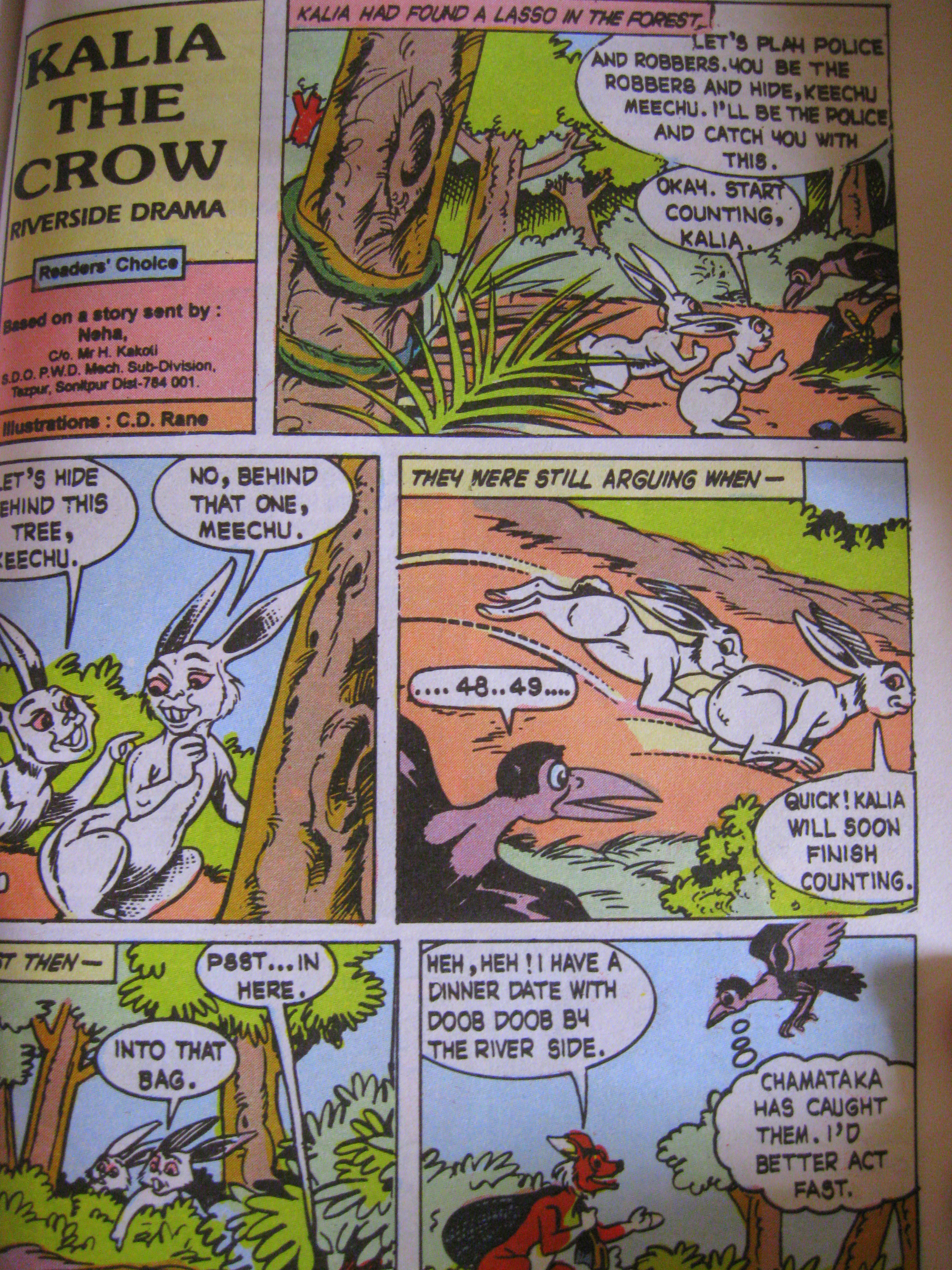
None of these caricatures were so extreme that people discriminated against foxes or crocodiles. Instead every tale would end with a moral. The clever fox ends up being a detective in some stories. Sometimes animals had higher morals than humans in these stories, rationalizing the right over the wrong and punishing the wrong-doers. Chamtaka and Doobdoob since they refused to heed Kalia’s advice, always choose to learn their lessons the hard way, owing to foolishness.
From this vividly rich corpus of literature emerged my present concern for crows. Unlike the Fox that has earned a sly and clever reputation in English (British) and Indian literature and comics, the Owl and the Crow share opposing statuses. While the Wise Owl is a common caricature in British literature, the Wise Crow is more of an Indian thing. The owl in Indian literature is a fool. Prof.Ramanatha Sharma (my first Sanskrit teacher from University of Hawaii, a traditional and illustrious Sanskritist from Benares) used to say, this is why the Hindi word for ‘fool’ is the same as the word for ‘owl’ – “ul-loo”.
In Tamilnadu especially, and in funeral and deceased relative rites (Shraddham), the crow is an important player and participant. Every Tamil girl has heard the story of the wise crow that stole the vadai (crispy salty fried donuts). A hungry crow alights upon a branch of a tree near the home of a vadai-making patti (grandmother). Overtaken by the smell of frying crispy vadais the crow cries out to the old lady to ask for some vadais.  The grandmother doesn’t notice but eventually has to leave the kitchen briefly, leaving a hot plate of freshly made vadais near the window sill. This crow excitedly goes and grabs one and brings it back to his branch where he hopes to eat it. However a fox passing by tempted by the free vadai hopes to cheat the crow and take his vadai. The fox praises the crow’s voice, asking him to sing a song for him, hoping that when the crow opens his mouth to sing, the vadai will fall straight into the gaping mouth of the fox. Crows cries have a reputation of being sore and hoarse and the crow quickly becomes aware of the sneaky plan by the fox. He carefully places the vadai between his claws and sings loudly till the fox is forced to leave because of the noise. Finally in peace the crow enjoys his vadai. There are several variations to this story as there are to any story in India. This crow in some versions drops the vadai and goes to get another one and then finally learns the fox’s trick. In other versions there are two crows and one tries to trick the other while being too lazy to steal a vadai for himself. There are even some versions where the crow is friendly and steals more than one vadai and shares it with the other animal. Whatever the version the crow story is a popular one in Tamilnadu and is familiar to anyone in the area. Crows are popular in the area and their familiar cries can be heard all over the city and countryside. They are all black but with a grey neck. They also don’t eat alone according to popular lore. They taste food and bring all their buddies to share their meal with them.
While scientists have deemed them scavengers, they also play a social and religious function for the Hindu community amidst whom they live. As I mentioned before the funeral and death rites (Shraddham) of Hindu ancestors are performed regularly in the areas surrounding temples by family members with the help of Brahmin priests. During this ritual pindas (balls of rice covered in black seaseme seeds) are made to depict the ancestors of a particular lineage. Crows are said to be ancestors in limbo, searching for food and dependent of humans for their leftovers. Towards the end of a Shraddham, these balls are placed in open spaces where crows gather and they are invited to partake in the offerings. While the priests are the main representatives to be fed in this ritual and the descendant male member who performs the ritual for their family member (owing to the importance of a son), the crows are the next most important participants for this ceremony. If crows did not partake in these pindas, it was a bad sign.
Not only during Shraddhams but every morning while living in Chennai, my mother used to always feed the crows even before she fed the family. My mom used to say that crows only eat fresh and hot rice. They do not even touch old rice. As a little girl I was so moved by these stories I used to tell my friends when I moved to Dubai that I had a pet crow in India.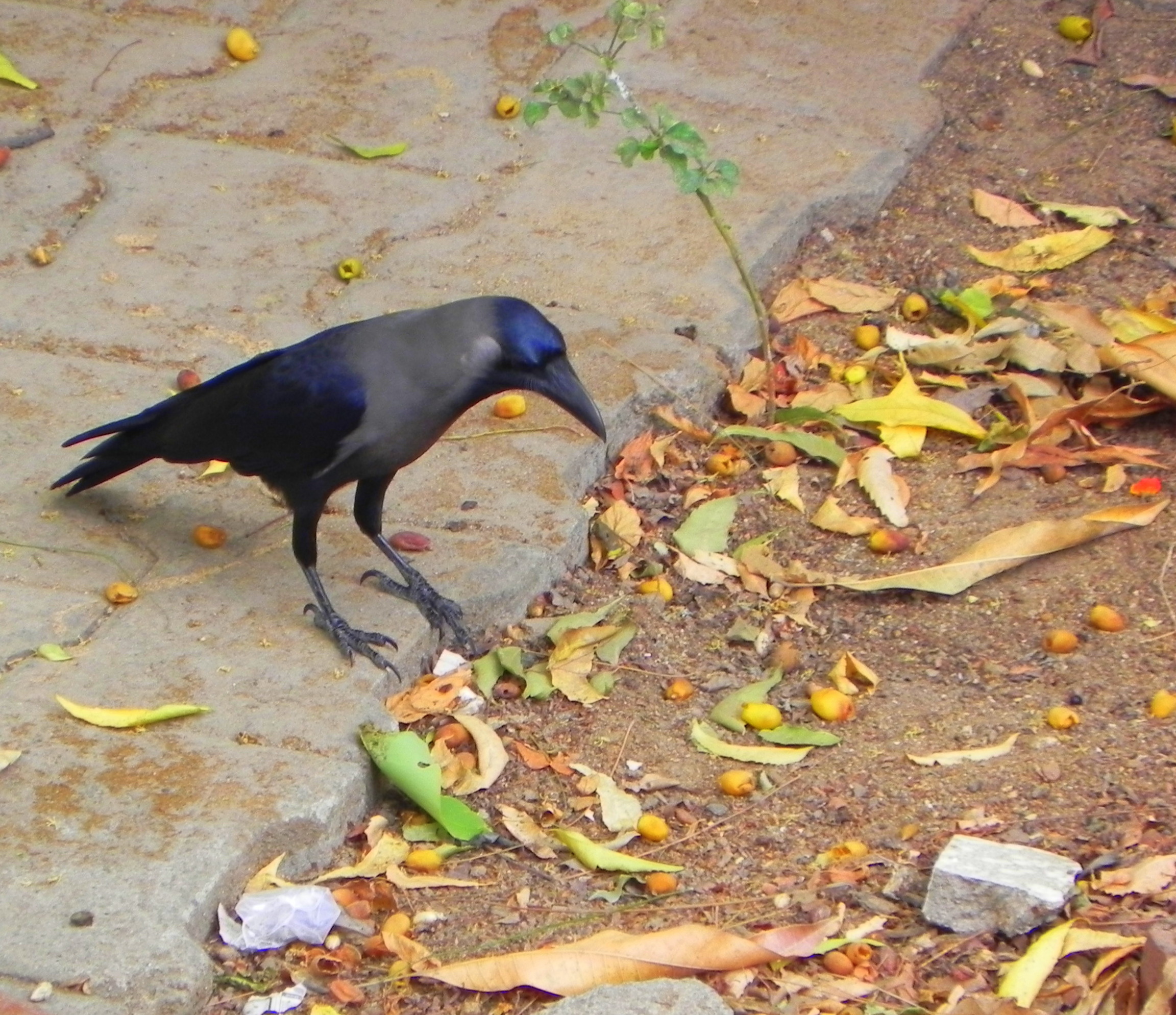
All this to say that increasingly in the hustle and bustle of the city life in Chennai, there are fewer crows. As soon as I arrived I noticed the lack of my pet crows even in my own neighborhood. A friend told me that people throw rocks at them and chase them away these days as they don’t want their pesky loud cries for food in their areas. I was very disappointed especially because my father was visiting to perform Shraddham to my deceased Grandfather and I was worried there wouldn’t be any crows. But whether it was my mother’s devoted feeding of the crows in our area or the fact that crows just happen to remember where food is available, within days of my arrival several crows started to gather outside our window and balcony. Maybe our neighbors hate us even more now?
But the Shraddham was going to be in a different location. There too the scarcity of crows was evident. I went up to the open area and saw a couple of dried up pindas which had remained untouched. I worried for my father. But crows are wise afterall. When my family’s priest began his chanting, a large echo rose from the room where the Shraddham occurred behind closed doors. I was waiting outside keeping a close watch on the pindas but from afar. Crows arrived upon hearing the Sanskrit chants that rang out loud and partook in the offerings, proving the ritual was efficacious.
I cannot make a plea to non-Hindus to save the crow, but I can ask that Hindus remember the important role they play in Tamil and Hindu rites and at least to stop throwing stones at them. Tenderly balanced within the eco-system and worldview of Tamils I fear something is being lost if we lose the wise Crow. If there are no crows to eat pindas, it transforms the efficacy of the Shraddham. The ebb and flow of a developing city however does change the eco-system and these changed will be something the ritual too will eventually have to grapple with.
“Bhaya –Bhakti” – dis-belief meddles in risky business
What is the relationship between fear and devotion? Oftentimes this relationship is articulated through soteriological concerns – salvific roles played by the divine in the coming of the end of the world. Abrahamic traditions also speak of a fear from the “Wrath of God” or the “Judgment of God”. However, bhaya-bhakti means ‘fear of the power of the goddess’. Meaning fear and resulting devotion, bhaya-bhakti is characteristically mentioned by devotees of the goddess in Southern India. The goddess here is considered very “hot” and temperamental. However this temperament is not irrational or volatile to moral humans. It only becomes volatile and uncontrollable once dis-believers ill treat the shrine of the goddess or disrespect another’s belief in the goddess. As the local people say, “You can be of any faith, but there must be a respect for the shakti (power) of the goddess in our area. You need not believe in our faith, but you must never disrespect her power, for her powers are beyond all of us.” It is upon this sense that I wish to share a story told to me by a devotee of the goddess in Tirupati as narrated by her:
In my native village there is an old rock. It is flat, smooth and circular, but it has a triangular chip upon its surface. This chip forms a crack upon the circular rock, making the rock look like a woman’s head with her hair parted. This rock is no ordinary rock, our family’s goddess Karpagambal lives in it. Her powers radiate from the rock.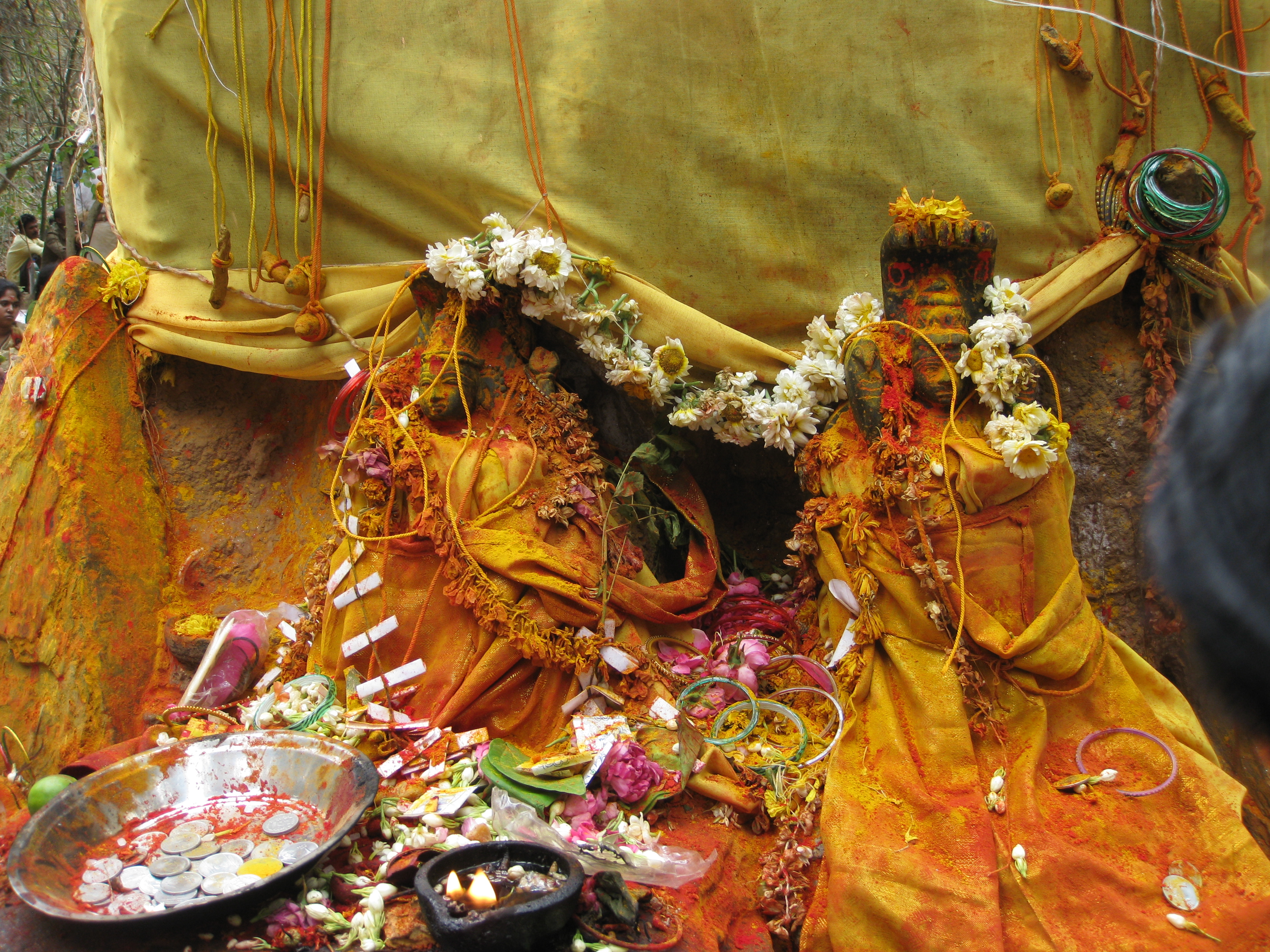
As the story goes, the villagers of the town used to worship Karpagambal in their own shrine upon the cross roads. With the coming of British officers and British employment opportunities (she said vella kārall/ “white people” in the area) our goddess was relegated to ‘superstition’ and no one wished to believe in her anymore, instead they all congregated towards Vishnu or other faiths. But the goddess did not remain silent. To mess with her powers is terrible. She had to make an appearance and so she did. One evening as a group of villagers were working upon a Brahmin landowner’s plot in the area to plough the field the plough stopped and hit upon that smooth faced rock (the above piece), leaving behind the chip and crack. They didn’t think much of it but the plough refused to move from there hindering their work.
That night a young girl came forth towards the old shrine of Karpagambal and cried out loud to the sleeping villagers – “oh you dis-believers, you think that I do not exist? This is only the start, there is much more I could do to stop your entire way of life. I am the goddess, Karpagambal, worship me with my favorite things – pongal (sweet rice porridge), vepa elai (neem leaves), raagi umbli (local porridge), and manjal thanni (turmeric water). I require a bathing every Tuesday with the juice of a special berry.” (Procuring this berry is hard, it is a long process to find it and then to extract the juice takes another few hours. If these are not done correctly one after the other, the berry juice also ferments making it unfit for the goddess.) “If you do not give me these offerings, you will all die and your race will be extinguished.”
Saying this, the young girl became unconscious and had a high fever for several nights. The villagers immediately recovered the stone, made a brick image of the goddess and worshipped with grand celebration on the following Tuesday. This ritual is still maintained till date. This is bhaya-bhakti, I was told, if you do not have fear, then the goddess will appear and make sure you realize her presence. Another woman agreed with my story-teller: “Once a woman bent over the rock to make offerings and by mistake slipped and her own hair parting touched the crack in the rock. She jumped back with fear and an “electric shock”, sensing the immense power emanating from the rock! This is what they say, bhaya-bhakti must be there.”
So to return to my earlier concern, what is the relationship between fear and devotion? The goddess’ judgment is not one that takes effect several years from now, while entering the gates of heaven. Instead the goddess’ judgment is immediate, and life altering, as they say. One could argue that the villagers were challenged and they worshipped the goddess out of fear that their race would be extinguished. On the other hand bhaya/ fear is central rather than in soteriological concerns where salvation is desired. The goddess doesn’t come to save humans but rather to invite devotion to her forms in this world. The goddess’ wrath is in the immobility of the plough, the possession of the little girl, and the surrounding mythologies that bring forth and sense of “this-worldliness” to the goddess’ presence and actions. Moreover, even today the local form of punishment in the villages and surrounding areas of Tirupati is not to call the police. Instead, wrong-doers are brought to the shrine of the goddess, tied to tree there and beaten with a stick. For lack of a better word, there is also a sense of this-worldly karma inflicted upon wrong-doers, assuaging the villagers from the threat of crimes in the area. Ethics – fear- devotion all seem to work hand in hand.
 bommalāttum